


MaskAlarm

Fall asleep without wondering if the mask is still on.

MaskAlarm turns a phone on a stand into a CPAP mask-off alarm. It watches while you sleep and wakes you, usually within 1-2 minutes, if the mask comes off — so you stop losing nights without knowing, and stop lying awake to check.

  • The old phone in your drawer will do. Any iPhone from 2017 on, or most Android phones from 2017 on (Android 8 or newer). Wi-Fi is all it needs.
  • It is still your phone. Calls and texts come through as normal. Answering a call may pause monitoring — just start it again.
  • Nothing to wear, nothing to wire in. Nothing attaches to the mask or the machine — a phone and a stand.
95%+ Detects mask-off events with over 95% accuracy in recommended lighting.
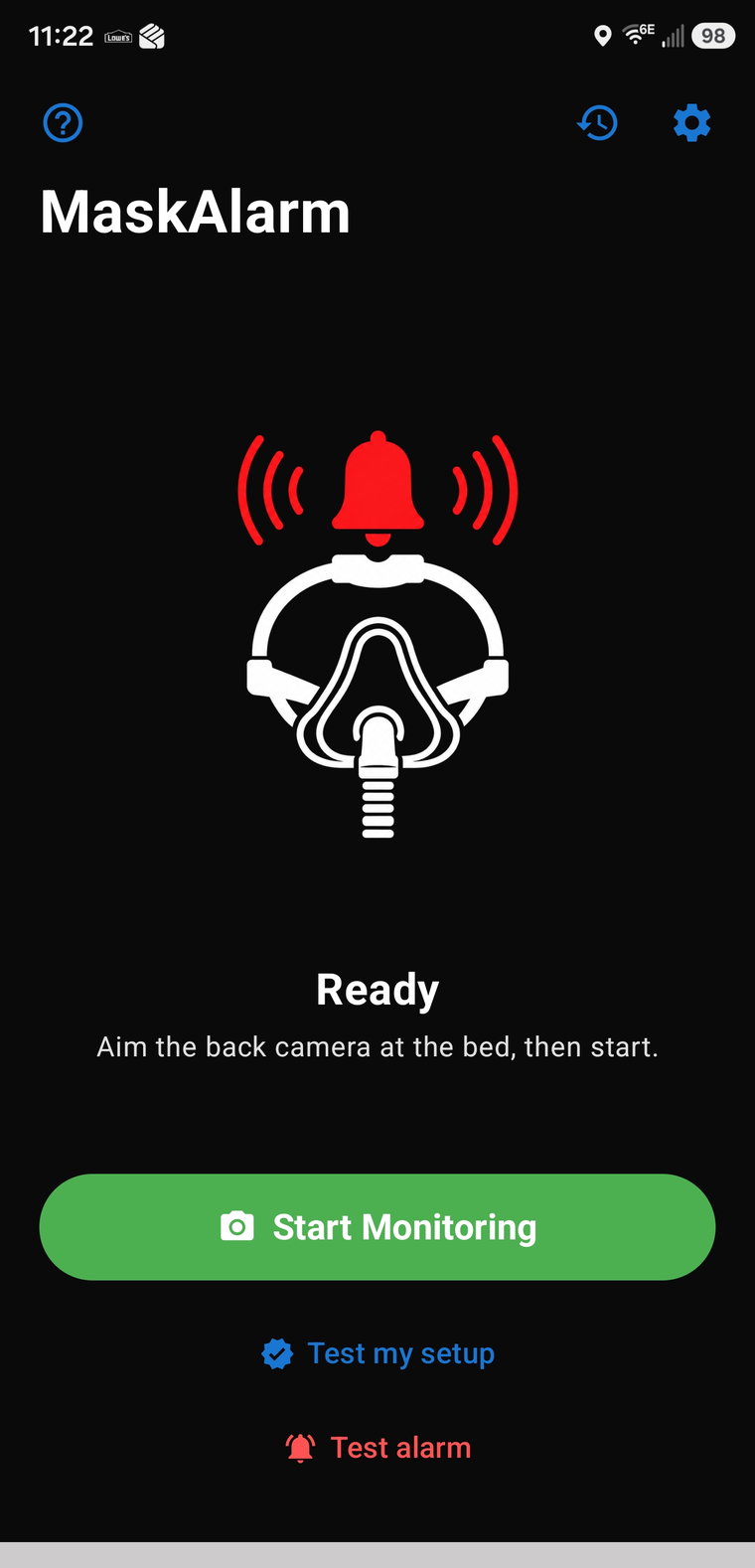
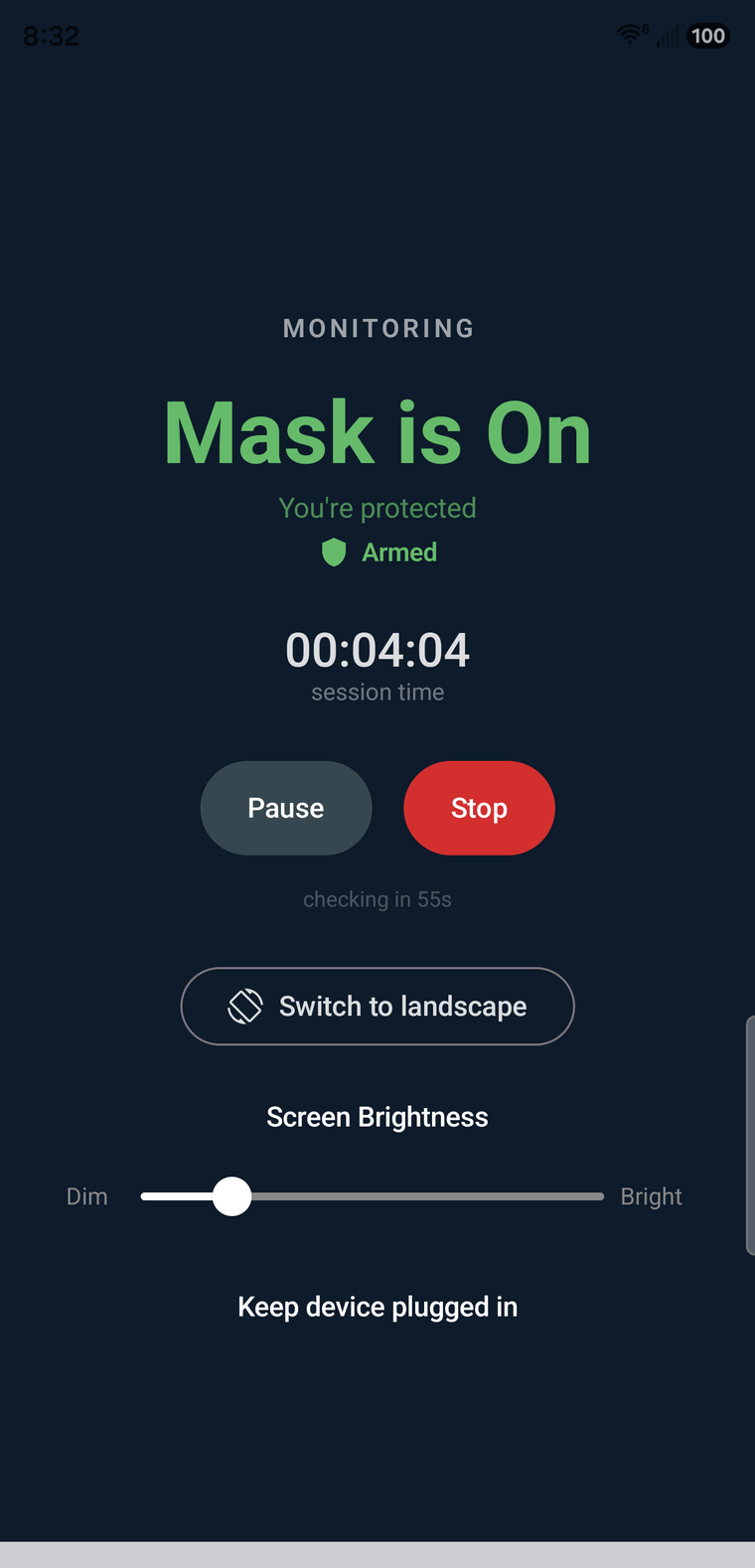
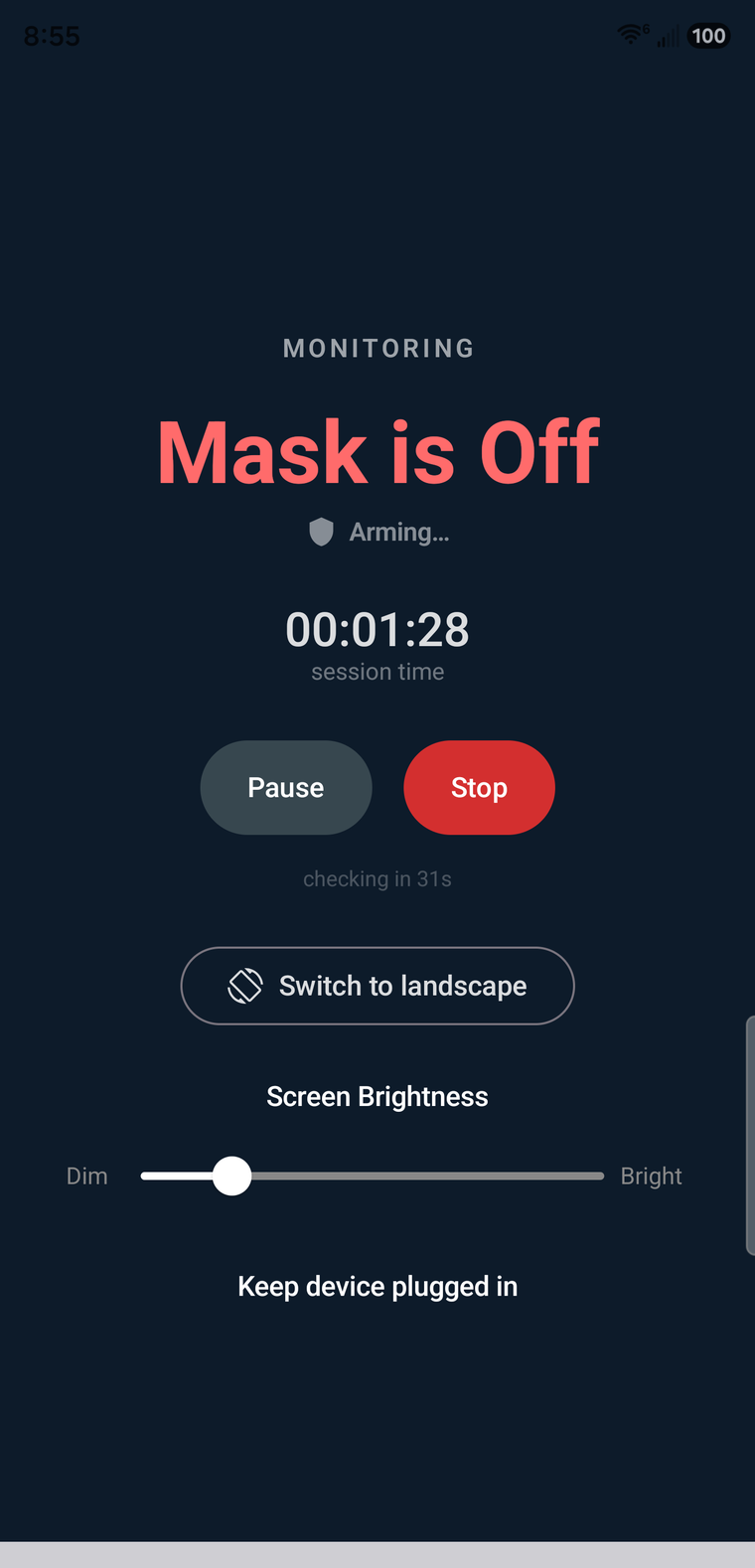
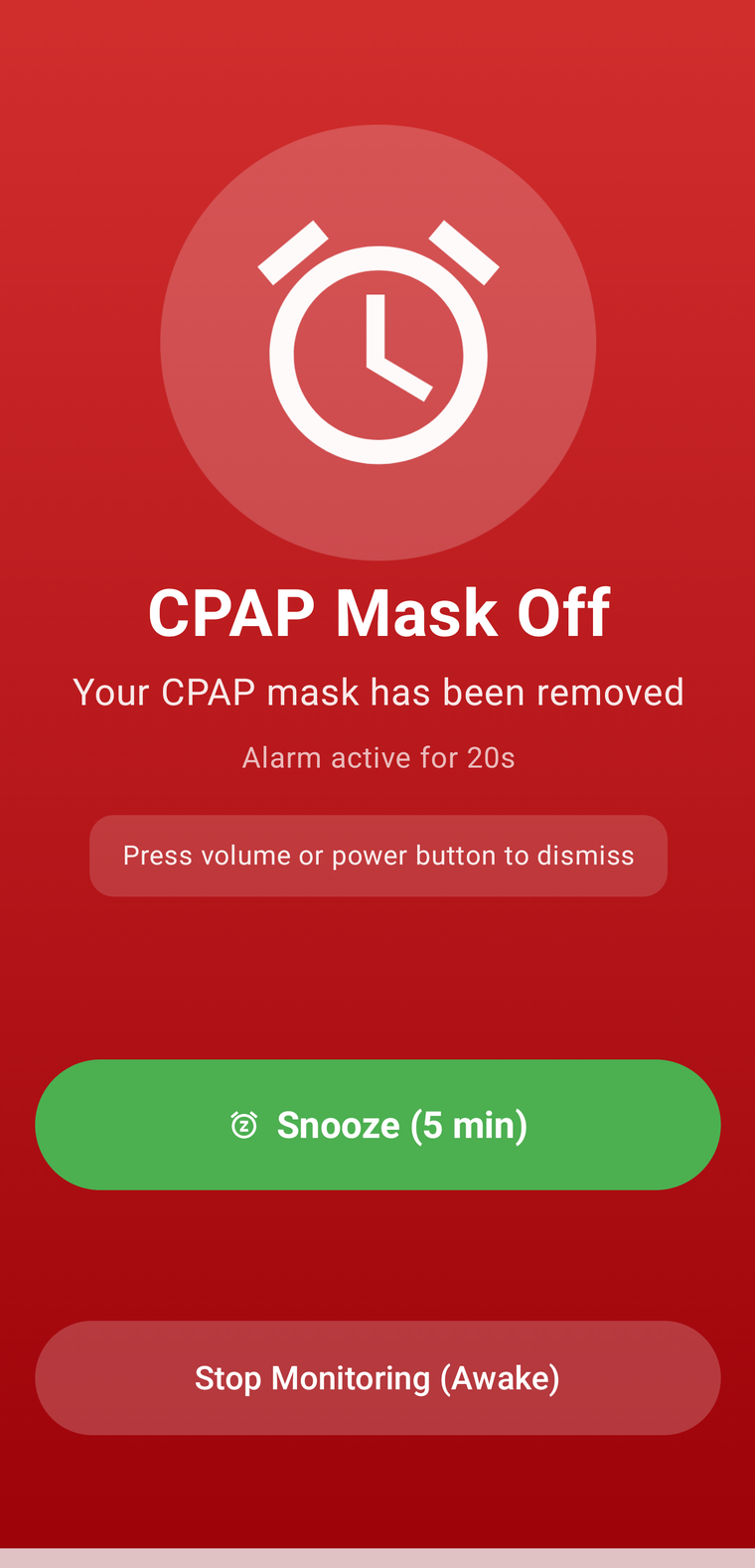
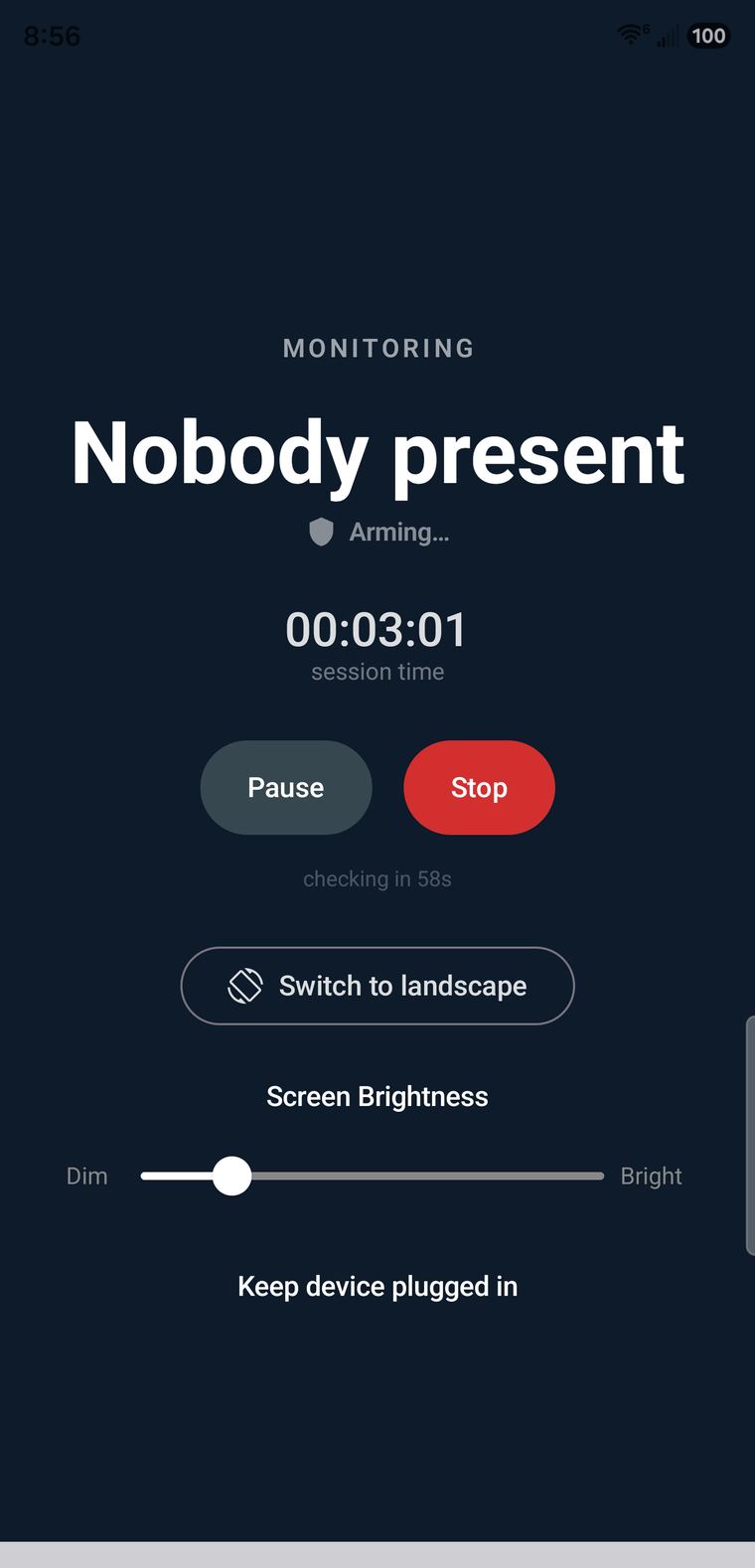
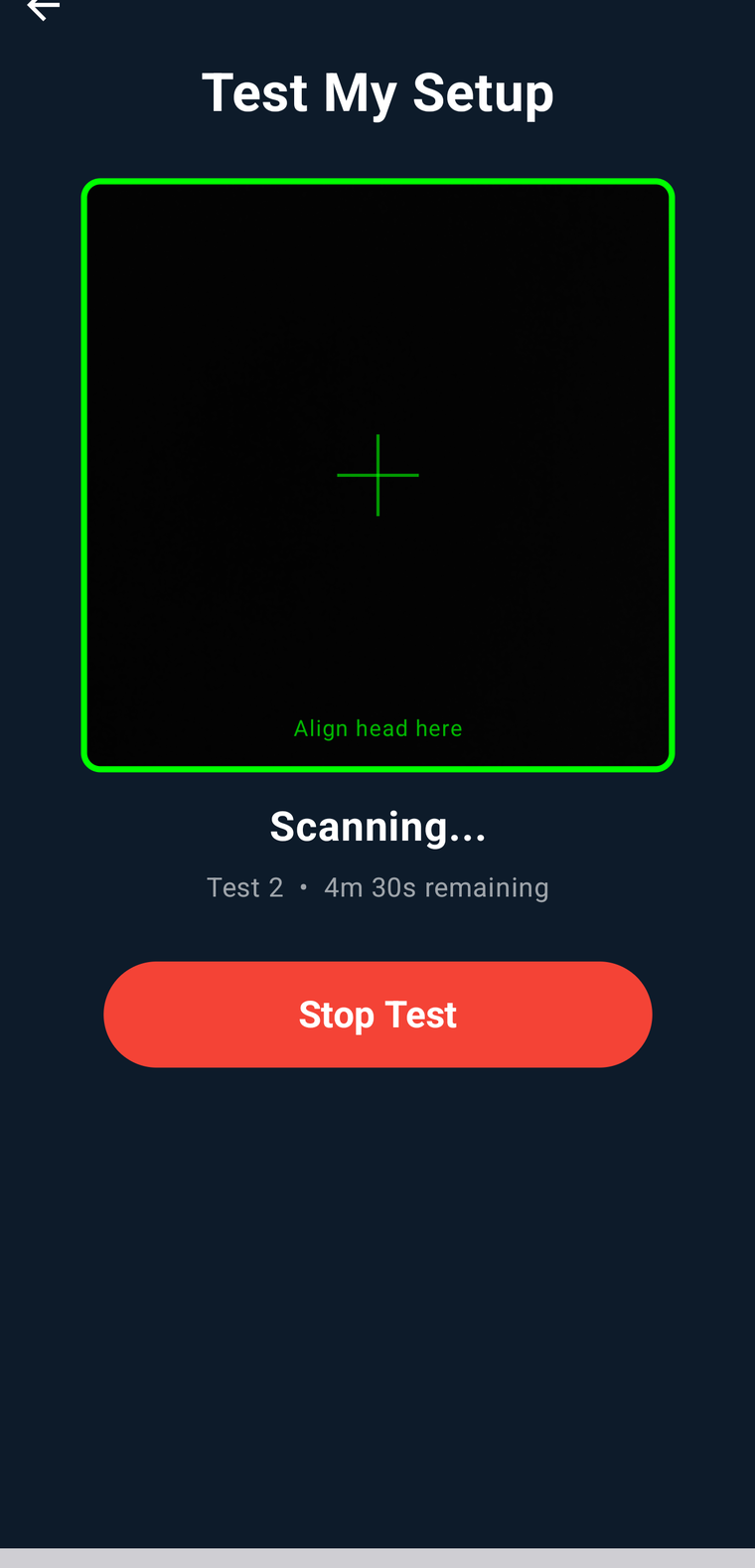
MaskAlarm app — CPAP mask-off alarm Ready screen with Start Monitoring Live monitoring — mask on, armed and protected Live monitoring — mask off detected Mask-off alarm — MaskAlarm wakes you to put your mask back on Live monitoring — nobody present AI Sleep Report — a plain-English summary of your night History — compliance streak, stability and weekly trends
Download on the App Store Get it on Google Play

App available in English · Español

Scan to install MaskAlarm on your phone Scan to install
Point your phone's camera here to get MaskAlarm.
Why it matters

A CPAP mask that slips off at 3 a.m. means hours of untreated apnea — and you sleep right through it. You wake up groggy, never knowing the mask was off half the night. A camera doesn't sleep.

How it works

Set your phone on a stand. Sleep. We do the rest.

1

Aim & arm

Prop your phone on a stand at the head of the bed and frame the pillow. The app arms itself once it sees you settled with the mask on.

2

Timely, watchful checks

While you sleep, the app takes small pictures and processes them only for mask detection — mask on, mask off, or nobody in bed. No picture is ever saved, on your phone or ours; each is encrypted in transit, used once, and discarded. Only the answer is kept. Pictures are never used to train AI or for ads.

3

Wake only if needed

If the mask comes off, an alarm wakes you usually in under a minute to put it back on. If it's on all night, you'll never hear a sound.

🌑

Built for the dark

Tuned to read your mask in a near-dark room. You are not required to have the room lit up.

🔁

Guards against false alarms

A confirmation step rules out a single stray reading before it ever wakes you.

⏱️

Won't run forever

Auto-stops after your set session length — a safety net if you forget to end it.

How the alarm decides

It won't wake you for a quick adjustment.

The alarm arms and double-checks before it ever sounds — so you're only woken when your mask is genuinely off. Here's exactly how it works.

WatchingQuietly keeping watch, hour after hour.
Mask comes offIt notices — and double-checks to be sure.
AlarmUsually under a minute.

It confirms across several checks before it ever sounds, so a shadow or a turn of the head won't wake you. Put the mask back on and the alarm stops by itself.

  • It arms first. When you start monitoring, it waits until your mask is detected on for 3 checks in a row before it's armed — confirming you're settled in.
  • It confirms before alarming. Once armed, a single removal won't wake you. It sounds only when the mask is off in 3 of the last 4 checks, so adjusting your mask is fine.
  • Get up freely. If no one's in view, it disarms automatically — no alarm. When you're back in bed with the mask on, it simply re-arms after 3 checks, at your own pace.
Caregiver alerts

Not in the room? Get the alert on your phone.

When the mask comes off, MaskAlarm can reach whoever's watching over the sleeper — by text or a loud app notification, on any phone, near or far. Up to three caregivers, and it's included in the subscription.

💬

Text or app notification

A regular text needs no app and reaches any phone (US numbers for now) — or the caregiver installs the free app for loud notifications on iPhone or Android.

📱

Any phone, any distance

Next room or across the country. One caregiver can watch over several people, and the free caregiver app never needs a camera or subscription of its own.

🎚️

You stay in control

Turn each caregiver on or off, send a test anytime, and choose whether the sleeper's own phone alarm sounds for each one. Included in the monthly subscription.

For dementia & Alzheimer's caregivers

A CPAP alarm for patients with Alzheimer’s and other cognitive declines who pull the mask off.

Sleep apnea and dementia go hand in hand — and the people who may benefit most from CPAP are often the least able to keep the mask on through the night. MaskAlarm watches when no one else can, and sounds an alarm that keeps sounding until the mask is back on — for as long as you set it to — so a mask pulled off at 2 a.m. can't be silently ignored.

Read the caregiver guide: how to keep a CPAP mask on someone with dementia →

55M people live with dementia worldwide, with nearly 10 million new cases every year (World Health Organization).
~5× higher odds of obstructive sleep apnea in people with Alzheimer's — research estimates about half are affected.
6.9M Americans age 65+ are living with Alzheimer's today (Alzheimer's Association) — many with untreated apnea on top of it.

Treating sleep apnea is linked in research to better sleep and slower cognitive decline — but a CPAP only works while the mask is on. Confusion, restlessness, and memory loss make nighttime mask removal common in dementia, and a caregiver can't stay awake watching all night. That's the gap MaskAlarm was built to close.

🔔

The alarm doesn't give up

Once the mask comes off, the alarm keeps sounding until it's back on or someone dismisses it — for as long as you set it to, up to 20 minutes. A removal in the middle of the night can't be slept through or quietly ignored.

👥

Alerts a caregiver, not just the patient

Notify up to three caregivers the moment the mask comes off — by text or a loud app notification, on any phone, near or far. Included in the subscription; the caregiver app is free. How caregiver alerts work →

🔁

Resumes on its own

The moment the mask goes back on, monitoring picks right back up — no tapping, no fiddling at 3 a.m.

MaskAlarm is a monitoring and alerting aid that helps keep prescribed CPAP therapy in place. It is not a medical device and does not diagnose, treat, or prevent dementia, Alzheimer's disease, or sleep apnea. Research on CPAP and cognition is ongoing — always follow your healthcare provider's guidance about diagnosis and treatment.

Sleep therapy & analysis

See how your therapy really goes.

MaskAlarm is more than an alarm. Every night it quietly tracks your CPAP use, then turns it into a clear picture each morning — so you know you're actually getting your therapy, and can catch problems early.

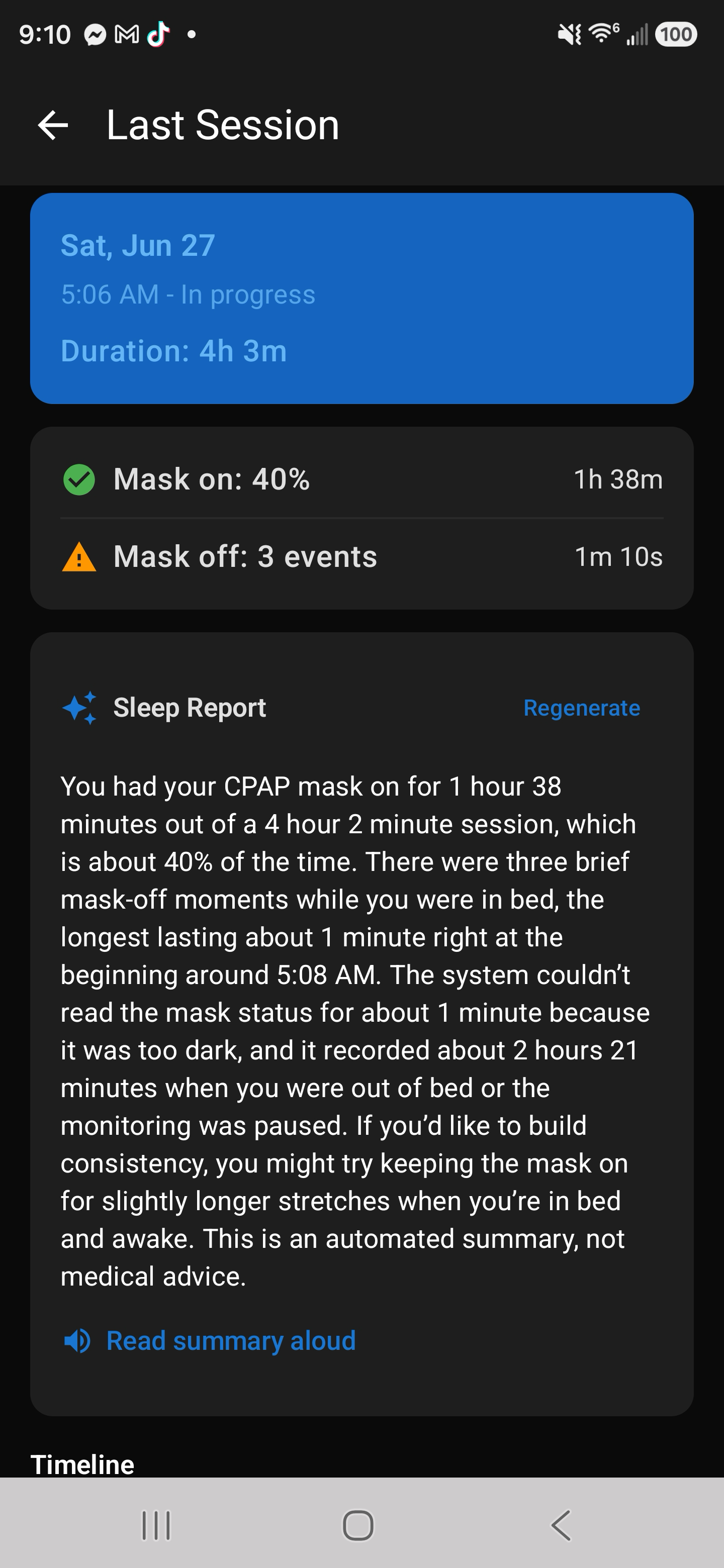
  • An AI Sleep Report every morning. A plain-English summary of your night — total mask-on time, when and how often the mask came off, and time spent out of bed — written for the night you just slept.
  • Compliance at a glance. See whether you hit the hours your therapy needs, without digging through your machine's data.
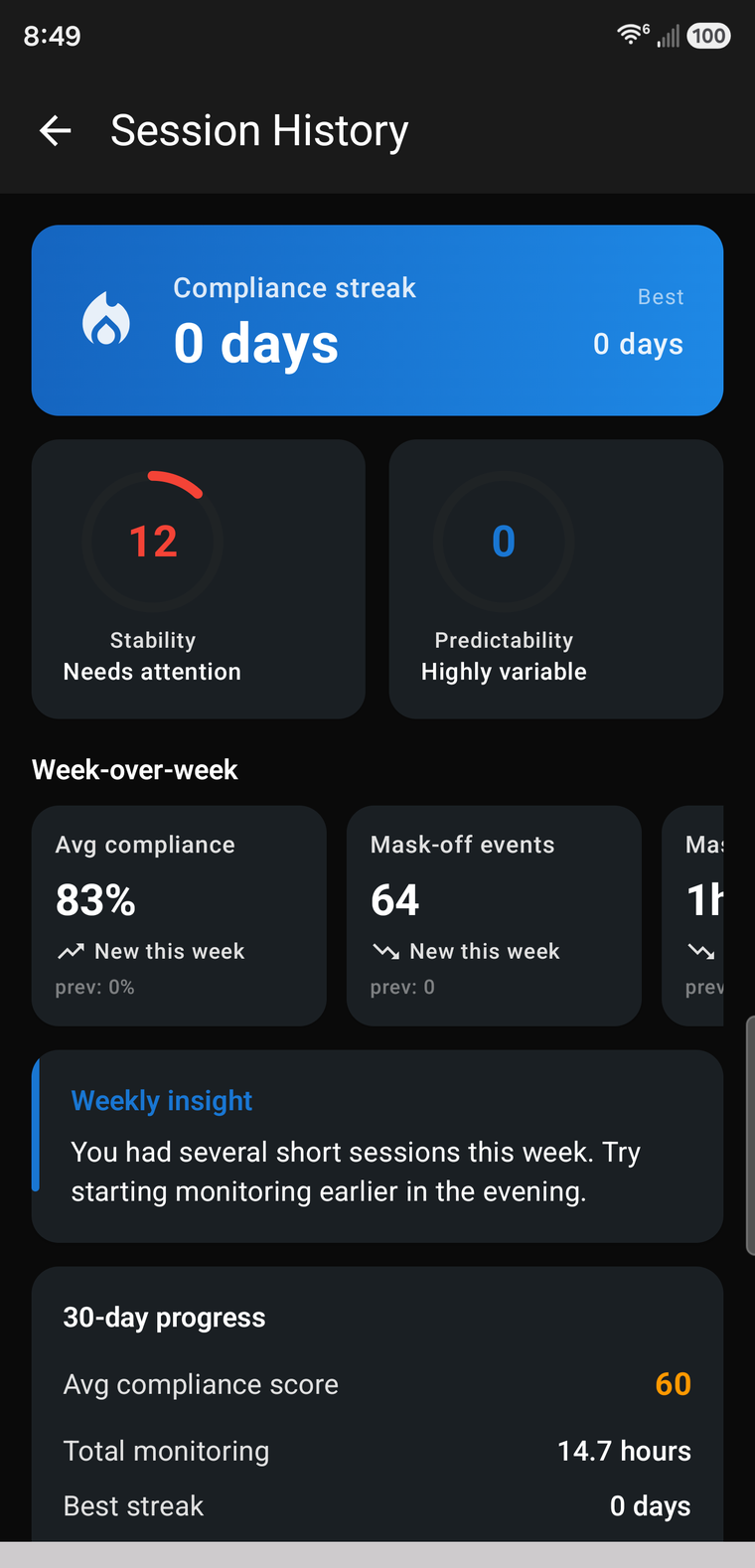
  • History & trends. Follow your nights over time to spot patterns, measure improvement, and see what's working.
AI Sleep Report — a plain-English summary of your night with mask-on time and mask-off events
Your AI Sleep Report
Sleep history — compliance streak, stability and weekly trends
Trends over time
Built-in help

Don't hunt through settings. Just ask.

Tap the sparkle icon and ask in your own words — typed or spoken. “How do I get an alarm when he gets out of bed?” gets a plain answer that says where the setting lives — and shows the actual control right in the answer, so you change it on the spot.

See it in action

What it looks like on your phone.

Pricing

Know the mask stayed on. Cancel anytime.

Try the whole app for a week before you commit — then pick the plan that fits how long you sleep.

See plan comparison ↓

7-Day Evaluation
$7.99 once

The full app for a week — every feature, nothing held back except detached-hose alerts. About 56 hours of monitoring over 7 days. It is a one-time purchase that simply ends: no auto-renewal, nothing to cancel.

or subscribe

The nightly hours below are an average, not a nightly limit. Each plan includes a set number of monitoring hours per billing cycle — sleep longer some nights and shorter others, it all comes out of the same pool. When the hours run out, monitoring stops until your cycle resets on your renewal date, or you can upgrade for more. See exactly how the hours work →

Standard
$69.99/month

Up to about 8 hours a night · 248 hours per cycle

The mask-off alarm — you're alerted usually within 1–2 minutes of the mask coming off — plus session history, sleep reports, caregiver alerts and best-effort hose-detachment alerts. Billed monthly. Cancel anytime.

Extended
$99.99/month

Up to about 12 hours a night · 372 hours per cycle

Everything in Standard with extra hours for longer nights and daytime naps. Billed monthly. Cancel anytime.

Continuous
$199.99/month

Around-the-clock, 24/7 · 744 hours per cycle

For households caring for someone who can't keep the mask on — day-and-night monitoring with caregiver alerts and best-effort hose-detachment alerts. Billed monthly. Cancel anytime.

Every plan covers a 31-night month at its typical night, so a long month never runs out a night early.

Organizations
$149.99 /seat /mo

For memory-care communities, assisted living and home-care agencies: seat licenses managed from one portal — every seat is Continuous + Hose, phones activate with a code (no app-store billing), seats are numbered never named, and a usage view covers every monitored night. Three-seat minimum.

MaskAlarm for organizations → Set up your organization now →
Compare

Every plan, side by side.

Feature7-Day Evaluation$7.99 onceStandard$69.99/moExtended$99.99/moContinuous$199.99/mo
Monitoring hours per cycle56 total248372744
Typical night it’s sized for~8 hr~8 hr~12 hr24/7
Mask-off alarm
How soon the alarm sounds1–2 min1–2 min1–2 min1–2 min
Session history & trends
AI sleep report
Caregiver alerts
Detached-hose alerts
Billingone-timemonthlymonthlymonthly

Alarm times are the outside case, at the fastest alarm setting — MaskAlarm confirms before sounding, and usually it is quicker. You can also choose a slower, more forgiving alarm in Settings.

Hours are a pool for the whole billing cycle, not a nightly limit — the nightly figures are averages. Hose alerts are included on every monthly plan; they are best-effort and work best with light-coloured bedding.

Reviews

From a caregiver who uses it every night.

Over the last couple of months, my husband, who has sleep apnea and dementia, has frequently awakened in the morning with his CPAP mask off or the hose disconnected. When this happens, he may wake up exhausted and remain tired for much of the day. Because of his cognitive condition, my husband involuntarily often takes off his mask during the night and forgets to put it back on again. I was quickly running out of ways to help him use his CPAP consistently—until I came across Mask Alarm CPAP Mask Off Alarm.

Since I first discovered Mask Alarm CPAP Mask Off Alarm and contacted the developer to explain our situation, the app has been updated numerous times with extremely useful features. These include extending the maximum session length, adjusting how quickly a mask removal is detected, sounding an alarm and providing verbal cues to put the mask or hose back on again.

Most helpful of all is the ability to send an alert to a caregiver’s device, either by text message and alarm or through a second paired device running Mask Alarm CPAP Mask Off Alarm in caregiver mode.

As his caregiver, I no longer have to wake up repeatedly to check whether his mask and hose are still connected correctly. Since we began using the app, my husband’s CPAP use has become much more compliant, and his reported nightly AHI has improved significantly.

I highly recommend Mask Alarm CPAP Mask Off Alarm to people who have difficulty keeping their CPAP mask on during the night, as well as to caregivers supporting someone with a cognitive condition who also has sleep apnea.

Maria · caregiver · July 2026

User-submitted video

One person’s experience, in their own words. Results vary, and MaskAlarm is not a medical device — it does not diagnose or treat any condition and is not a substitute for prescribed therapy or your doctor’s advice.

🔐 Straight talk on privacy

No picture of you is ever saved — anywhere. Not on your phone, not on our servers, and there is no setting that turns saving on. Each picture exists only for the seconds it takes to answer one question: is the mask on?

While monitoring, the app takes small pictures of the sleeping area, encrypted in transit, and sends each to an AI provider that returns the result and handles it under its own privacy policy. The picture is then gone. Only the answer is kept — mask on, mask off, or nobody in bed — along with the time. Pictures are never used to train AI, never sold, and never used for advertising.

You'll be asked to consent before monitoring begins. Full details live in our Privacy Policy.

⚕️ An aid, not a medical device

MaskAlarm is a comfort and convenience aid. It is not a medical device, does not diagnose or treat any condition, and is not a substitute for your prescribed therapy or your doctor's advice.

It can miss events and should never be your only safeguard. See the Terms of Use.

Available now

Sleep easier — in just a couple of days.

MaskAlarm is available now on the App Store and Google Play.

Download on the App Store Get it on Google Play
My story

Why I Made MaskAlarm

Victor Boba, founder of MaskAlarm

I built MaskAlarm because I have obstructive sleep apnea.

Like a lot of CPAP users, I had the same frustrating experience over and over. Somewhere in the middle of the night—completely asleep—I would pull my mask off without ever realizing it. I'd wake up the next morning, find the mask lying on the pillow beside me, and discover I'd only received an hour or two of therapy. The rest of the night? Nothing.

If you've experienced that, you know how discouraging it can be.

I've been a software engineer for more than 30 years, so instead of accepting the problem, I decided to solve it.

About two years ago, I built my first prototype. It ran on a tiny microcomputer beside my bed and periodically took pictures while I slept. The software compared each image to reference photos of me wearing my CPAP mask to determine whether it was still on. It actually worked—but only for me. Anyone else would have needed to look exactly like I do.

Then I realized AI could solve the problem much more elegantly.

Instead of comparing faces, it could answer a much simpler question: Is this person wearing a CPAP mask or not? That insight became the foundation for MaskAlarm.

I'm a husband, father of three, former U.S. Marine, and lifelong engineer. Good sleep isn't a luxury—it's essential. There was a point where I would have gladly paid almost anything for a tool that could wake me the moment my mask came off. I searched everywhere, but nothing like it existed.

So I built it.

The feature I'm most proud of is also the simplest. When your mask comes off, MaskAlarm sounds an alarm. You don't have to unlock your phone, fumble through buttons, or even get out of bed. You simply put your mask back on. The app recognizes that your mask is back in place, automatically silences the alarm, and lets you go right back to sleep.

No extra steps. No bright screens. No frustration.

Just a simple idea designed to help you get the therapy your doctor prescribed and the restorative sleep your body needs.

If MaskAlarm helps you wake up feeling better—even one more morning than you would have otherwise—then every hour I spent building it was worth it.

Thank you for giving it a try.

Victor BobaFounder, MaskAlarm